

Have you ever felt like you’re getting a great deal on something, only to realise later that it wasn’t quite as good as you thought? It might not just be in your imagination. Businesses often use sneaky pricing tactics to make their products or services seem more appealing.
From restaurants to online stores, retailers employ clever tactics to make things look cheaper, more valuable, or simply irresistible. Whether it’s a small change in the numbers or a sale that seems too good to be true, these psychological pricing tactics are designed to encourage you to spend more.
As a personal finance expert with a strong background in marketing and advertising, I’ve seen firsthand how businesses use subtle pricing tactics to influence your spending habits. In this article, I’ll break down some of these strategies to help you become a more informed shopper.
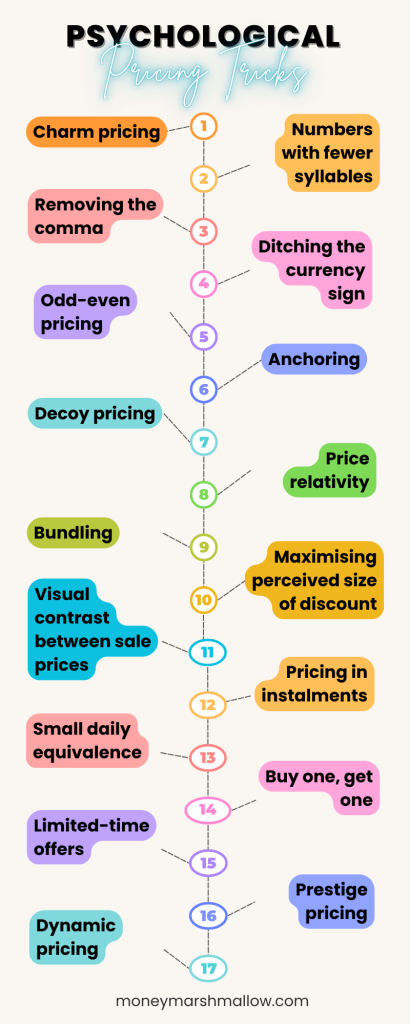
16 examples of psychological pricing tactics
Let’s learn some of the most common pricing tactics that can be used to encourage consumers to overspend.
1. Charm pricing
Charm pricing is one of the most well-known pricing tricks used. This subtle tactic involves using prices ending in .99 (e.g., £9.99 instead of £10). The decimal point creates the illusion of a lower cost.
Psychologically, this strategy works because our brains focus on the left digit, making us perceive £9.99 as significantly cheaper than a round number. This subtle shift can trigger feelings of getting a good deal, encouraging more purchases.
2. Numbers with fewer syllables
Phonetically shorter prices can feel more appealing to consumers. For example, £28.16 has five syllables, while £27.82 has seven. Even though both prices are close in value, studies show that people perceive the shorter price as cheaper.
This perception occurs because our brains process simpler numbers more easily. When faced with a price that rolls off the tongue, you may be more inclined to make a purchase, thinking you’re getting a better deal.
3. Removing the comma
Removing the comma is another psychological pricing strategy that can create the perception of a lower cost. For example, £1,629 may feel more significant than £1629, even though both represent the same total.
The reason behind this is that prices in the thousands tend to enlarge the phonetic size; saying “one thousand six hundred and twenty-five” takes ten syllables compared to just “sixteen twenty-five” for $1625. This psychological effect occurs because the comma breaks up the number, drawing attention to its larger value. Without the comma, the price appears less daunting and easier to digest, making it seem more affordable.
Related: 14 Clever Retail Psychology Tricks That Make You Spend More
4. Ditching the currency sign
Prices without the pound or dollar signs feel less tied to spending real money. When you see “50” instead of “$50” or “£50,” the absence of the symbol makes the price seem more abstract.
This is a common trick, especially in restaurant menus, where dropping the currency sign creates a subtle psychological distance, making the cost feel less significant. Without the visual reminder of money, it’s easier to focus on the purchase itself rather than what you’re spending. This strategy encourages more comfortable decision-making.
5. Odd-even pricing
Odd-even pricing plays on the perception that odd numbers convey savings, while even numbers suggest quality.
For example, an odd number price like £19.99 feels like a low price and implies a good deal, encouraging you to make a purchase. On the other hand, an even number price like £20.00 gives a sense of balance and quality, often used for premium products.
This psychological pricing strategy helps businesses influence how you perceive a product’s value, whether they want to highlight affordability or emphasise high-end appeal.
6. Anchoring
This pricing tactic plays on our natural tendency to base decisions on the first piece of information we see. By creating a visual difference between an initial high price (the anchor) and a lower one, businesses influence how we perceive value.
For example, you might see a sofa priced at £799, then marked down to £499. That initial high price serves as an anchor and makes the second price seem like a much better deal. Even though the actual value hasn’t changed, you’re more likely to feel like you’re getting a great deal thanks to this simple comparison.
Another great example is a restaurant that might list an extremely expensive steak on the menu to make the other options seem more affordable.
Related: How Restaurants Use Psychology to Make You Order More
7. Decoy pricing
Decoy pricing uses a third, less appealing option to steer you toward a more expensive choice.
This is a common psychological strategy at IKEA. For example, you might find three versions of a product: a basic chair for £50, a slightly nicer one for £120, and a high-end version for £130. The £120 option is the decoy—its close price to the £130 chair makes the higher-priced option seem like much better value.
Psychologically, you’re nudged toward the more expensive choice, as the slight price difference makes it feel like you’re getting the best deal without overspending. This tactic subtly guides your decision-making without making the most expensive choice feel forced.
8. Price relativity
Price relativity influences your perception of value by directly comparing similar products at different prices. Unlike decoy pricing, where a less attractive middle option pushes you toward a more expensive choice, price relativity makes you focus on the differences between two or more products to feel like you’re getting a better deal.
For example, if one chair is £100 and another is £200, the £100 chair seems like the best value simply because it’s cheaper in comparison. This tactic plays on the human tendency to judge prices relative to each other, rather than on the product’s actual worth.
9. Bundling
Bundling involves grouping products together to create a perception of greater value.
A well-known example is the meal deals at McDonald’s. You might be tempted to purchase a burger on its own for £3.50. However, when you see the option to add fries and a drink for just £5.99, the bundled offer feels like a better choice. This pricing trick encourages you to spend more money and buy the full meal instead of just the burger you initially wanted.
Psychologically, the bundled price makes consumers feel like they’re getting a good deal, even if the individual items aren’t discounted. By presenting products as a collective offer, businesses can effectively increase sales while making customers feel savvy about their choices.
10. Maximising the perceived size of the discount
Maximising the perceived size of a discount involves retailers highlighting the largest possible number to label their discounts. For instance, advertising “20% off” a £50 vacuum cleaner sounds much more appealing than saying you save £10, even though both discounts amount to the same savings.
In addition, percentage figures often appear larger and more impactful than absolute pound amounts to the human brain. When you see a high percentage off, it can trigger feelings of getting a great deal, which encourages quicker purchasing decisions.
11. The visual contrast between sale prices
Visual distinction between the sale price and the original price is powerful. Retailers often display the sale price in large, bold font while presenting the original price in a smaller, lighter typeface.
For example, you might see a tag that reads “£49.99” in bold letters next to “£69.99” in a lighter font. This stark contrast draws your attention to the savings, making the sale price seem more attractive.
12. Showing pricing in instalments
Another common tactic used by businesses is to present prices in instalments. This is because consumers tend to get anchored on a smaller price subconsciously, even when they know the total price.
By breaking down the cost into smaller, more manageable chunks, businesses can make the purchase seem less daunting and more affordable.
For example, an Apple phone might cost £1,000 upfront. However, a monthly payment plan of £83.33 over 12 months can make it seem less expensive.
13. Small daily equivalence
Another common pricing tactic is to compare the cost of a product or service to something familiar and everyday, like a cup of coffee. This strategy can make the price seem more affordable by providing a mental reference point.
For example, a gym membership might be advertised as “the cost of a cup of coffee per day.” This comparison can make the monthly fee seem less expensive and more likely to be perceived as a worthwhile investment. By framing the cost in terms of something familiar and affordable, businesses can reduce the psychological impact of the price and make the purchase more appealing to consumers.
14. Buy one, get one (BOGO)
You’ve likely encountered Buy One, Get One (BOGO) promotions countless times. These offers are a classic pricing tactic designed to encourage you to purchase more. By offering a second item at a discounted price or for free, businesses create a sense of urgency and value, making it more likely that you’ll add additional items to your cart.
BOGO promotions are often highly effective for retailers in increasing sales and attracting new customers.
15. Limited-time offers
Similar to BOGO, limited-time offers are one of the most common pricing strategies to make you spend more. This is an effective pricing strategy because it helps to create a sense of urgency. This on the other hand can motivate you to act quickly before the opportunity expires, and make impulse purchases you don’t need. For example, you might have seen flash sales, countdown timers, or limited-quantity promotions online or in stores.
16. Prestige pricing
Prestige pricing is a strategy where businesses set higher prices to signal luxury, exclusivity, or superior quality. This tactic is often used for high-end products or services, such as designer clothing, luxury cars, or premium electronics.
By setting a high price, businesses can create a perception of prestige and desirability. Consumers may associate higher prices with higher quality, better performance, or greater exclusivity.
However, it’s good to remember that a premium price point doesn’t always reflect premium quality. Sometimes, businesses simply want you to believe that’s the case.
17. Dynamic pricing
Dynamic pricing is a pricing strategy where businesses adjust prices in real time. By considering factors like demand, customer behaviour, and market conditions, businesses can set prices that encourage instant purchases.
Dynamic pricing can create a sense of urgency, as consumers may feel pressured to purchase before the price increases.
Uber, airlines and hotels are prime examples of businesses that frequently use dynamic pricing. By monitoring factors like flight availability, booking trends, and competitor pricing, airlines can adjust ticket prices to fill seats and maximise revenue.
Why are psychological pricing tactics effective?
Psychological pricing methods work because they tap into our human brains and exploit our cognitive biases and emotional responses. Pricing strategies are often used to lure us to lower prices and discounts but also to improve the perceived value of products or services (such as luxury items).
Most of these strategies use psychological principles such as anchoring, scarcity and visual cues. For example, anchoring can be used to make a product seem more affordable by presenting a higher price first. On the other hand, scarcity can create a sense of urgency and desirability. Finally, different visual cues like leaving out currency signs or not using commas, make the most of the way our brains process information.
Ultimately, the goal of psychological pricing strategies is to influence our decision-making process and make us more likely to purchase products or services.
How to outsmart retailers' pricing tricks
While retailers often use clever tactics to make you spend more, the good news is that you can take steps to avoid falling victim to these pricing tricks. Become a savvier shopper by following these practical tips:
- Recognise the impact: Recognising the impact of these pricing strategies is the first step to becoming a more savvy consumer. By becoming aware of these strategies, you can reduce impulsive purchases and make more informed decisions.
- Try the 30-day rule: If you see a pricey new product you’re tempted to buy but haven’t budgeted for, wait 30 days before making a decision. This can help you avoid impulse purchases and assess whether the item is truly a necessity. Sometimes even sleeping on it might do the trick!
- Consider the personal value of an item or service: Instead of focusing solely on the price, evaluate the value it will bring to your life. Will it provide true happiness, joy, utility, or enhance your lifestyle?
- Stick to a weekly budget: If you tend to make impulse purchases, set a budget for discretionary spending and stick to it. This will prevent you from overspending and help you stay within your means.
- Compare prices: Don’t rely solely on the initial price displayed on a product. Take the time to compare prices across different retailers and websites to ensure you’re getting the best price.
- Negotiate: For certain products or services, negotiation can be a powerful tool. Don’t be afraid to haggle and try to get a better price.
- Avoid exposure: To avoid impulse purchases, limit your exposure to triggers that can tempt you. If you find yourself particularly susceptible to impulse buying, try the following strategies such as avoiding window-shopping, unsubscribing from marketing newsletters or reducing scrolling on social media.
Conclusion
We’ve all fallen victim to the illusion of a great deal. Retailers are masters of using psychological pricing tactics and magic numbers to entice us to spend more.
By understanding these strategies, you can become a savvier shopper and avoid falling prey to them. This can help you stay within your means, make the best financial decisions for your situation, and maintain control of your cash.